Do you use Rate My Professor?
2024-10-02T00:00:00.000Z
By Kana Sakamoto, Skylar Brunk, Matthew Blancett
Class is a huge portion of college life, and for many
students, it is important to pick courses taught by “good” professors. Since Rate My Professor
functions as a principal resource for students, we were curious if students really use the site and
whether they believe it to be reliable. First we asked the students about the site.
Skylar: Do you use Rate My Professor? Don’t worry this isn’t sponsored. My name is Skylar.
Kana: My name is Kana.
Matthew: And my name is Matthew.
Skylar: and we are going to be asking Oberlin students if they use a website called rate my
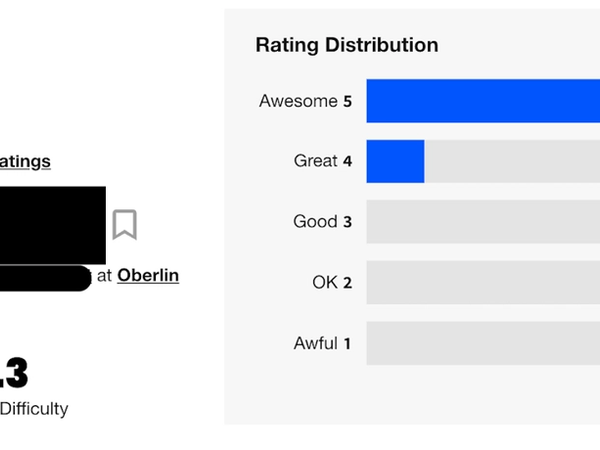
professor. If you don’t know what this website is, Rate My Professor is an online site where
students can leave reviews about their professors. Rate My Professor uses a five star system.
Five stars is the best, one star is the worst. Class is a huge portion of college life, and for many
students, it is important to pick courses taught by “good” professors. Since Rate My Professor
functions as a principal resource for students, we were curious if students really use the site and
whether they believe it to be reliable. First we asked the students about the site.
Kana: So, can I ask your name?
Jacob: Yes. I'm Jacob.
Kana: What year are you?
Jacob: I'm a third year at Oberlin College.
Kana: So, do you use Rate My Professor to pick your class?
Jacob: Yeah, I do sometimes.
Kana: Why do you use it?
Jacob: Well, I wanna see if people like my professors or what they're like during office hours or
lectures.
Kana: Do you think it's reliable?
Jacob: Um, I think a lot of the people on Rate My Professor are only going on there to write
reviews if they're upset with their professor or if they get a bad grade or something. But a lot of
other times you see, like, I don't know, I like seeing instances of the professor, like, moments that
are captured.
Kana: Do you use other factors to select your course?
Jacob: Um, the content. Course content, course description.
Kana: Compared to your first year, Do you use more or less?
Jacob: Um, I probably use rate my professor more.
Kana: Do you have any reason for that?
Jacob: Um. less intro classes. I think it's more important at a higher level because a professor
may be teaching something that they have research in or not, compared to 101.
Kana: Thank you so much.
Skylar: Hi, can you say your name?
Johannes: My name is Johannes.
Skylar: What year are you?
Johannes: I'm a fourth year.
Skylar: Do you use Rate My Professor to select your courses?
Johannes: Occasionally, but not that often.
Skylar: Do you think it's reliable?
Johannes: I mean, I don't think many people just straight up tell lies. There's probably a lot of
people, though, [who] have varying perspectives. Some people, like, think that getting
challenged, think that having a professor who challenges them is bad, other people in another
field just find all sorts of things to complain about.
Skylar: As a fourth year, do you think you've used Rate My Professor more this year in
juxtaposition to other years?
Johannes: No.
Matthew: Hi, can I get your name?
James: James.
Matthew: What year are you?
James: I'm a second year.
Matthew: Okay, gotcha. Do you use Rate My Professor to pick your classes at all?
James: Yes I do, but I feel like there's better ways to do so.
Matthew: What other ways do you use then?
James: I say, like, just ask around. At least I'm on a team, so I ask my upperclassmen, “what
classes are like?” or “what professors are easier?” “Which ones are better?”
Matthew: Did you use Rate My Professor more in your first year, or less in your first year, or has
it not really changed?
James: Um, I used to a little bit more in my first year. Yeah.
Matthew: And would you say that the reports on Rate My Professor are reliable at all?
James: Um, some of them can be a little biased because they just don't like the teacher, but, um,
but yeah, so far, yeah.
Matthew: All right. Thank you so much.
James: Yeah, of course.
Kana: Next, We had the chance to interview some of the professors whose profiles are on Rate
My Professor.
Matthew: Can I get you to say your name?
Prof. Marx: Sure. So my name is Chris, my last name is Marx, I'm a professor in the Math
Department.
Matthew: Do you ever check Rate My Professor?
Prof. Marx: I haven't checked it in a very, very long time. I've checked it in the past. It tends to
have sort of extreme opinions so that either students who are very happy and then other students
who were not very happy. So I work really more with the SETs with the students experience of
evaluation because it's a little more, it gives a more useful picture that I can work with also in
future classes.
Matthew: Can you explain SETs to me really quickly?
Prof. Marx: So, SETs is student experience of teaching, and so these are questions that ask
students about their experience in the classes. Or considers what their learning experience was,
so it has learning as a focus and not just a rating of a person, because there are biases that come
with ratings of people, and so the college designed this so that the biases were minimized.
Matthew: Do you think your professor is reliable?
Prof. Marx: No.
Matthew: Can I get you to say your name?
Prof. Parris: Chris Parris. I'm in the sociology department. I'm also affiliated with environmental
studies.
Matthew: So do you know the website, Rate My Professor?
Prof. Parris: Yes.
Matthew: Do you ever check that to see entries on your own profile?
Prof. Parris: Not really, no. I think it is, at least what I found is, is it tends to be an outlet for
students who have either really, really fantastic experiences and want to talk about it or have a
really negative experience and want to kind of vent about it. And there's, it seems to be a place of
extremes, I've kind of found. And so for me, I really focus on instead looking at my student
evaluations of teaching at the end of the semester. I also do mid semester evaluations with
students in my classes so they can add advice and have input on how the course is going.
Matthew: Do you find Rate My Professor reliable?
Prof. Parris: Not particularly. But again, I'm, so, being a sociologist. This is totally based on
anecdotal evidence. So I couldn't say for sure. I haven't done, like, actual research on it, but just
for my own personal anecdotal experiences. Um, not particularly.
Matthew: Could I get your name?
Prof. Newhall: Yes, it's Caroline Newhall.
Matthew: What department are you in?
Prof. Newhall: I'm in history.
Matthew: Do you check your Rate My Professor profile and do you think about your reports
from students are reliable?
Prof. Newhall: I would say they're pretty reliable. They're kind of out of date at this point. I
haven't had new ones in a while. So it is funny to look back and see kind of where I started as a
professor and how I think I've changed ever since. But I think it's nice to have. Some sense of
how students are taking my courses and it definitely tends to be, you know, the best and the
worst. So the middle of the road is usually absent. It can be a helpful tool, even if there are
definite issues with how it's reported and how it's all set up.
Matthew: And do you ever take the criticism that you're given in your profile to account?
Prof. Newhall: The nice thing is, it's kind of a data point in a sea of other data points. One thing
professors really rely on our student feedback forms at the end of every semester. They're really,
really vital for helping us improve, recognizing what is working as well, what is, you know,
maybe requires a little extra work, but that's something we're also constantly trying to figure out
as well, especially, you know, as a newer professor, I've been teaching for just a few years.
And so I'm constantly securing feedback from students from my peers, and we get observations
from our fellow faculty, which is always really helpful. So we're getting it from all sides. So I see
Rate My Professor is kind of one of those many tools in the toolbox that can be helpful.
Matthew: Through these interviews, we learned that both students and professors have various
opinions of Rate My Professor and use the site in different ways, with professors generally
preferring other means of review, while students are more likely to use the site. After conducting
this interview, it seems that Rate My Professor will be here to stay as long as there are students
who hope to achieve the best possible learning experience and want a “good” professor, although
the reliability of the site may be up for debate.