Exploring AI in Academics
2025-02-03T00:00:00.000Z
By August Butler, Isabella Moss, Lily/Gabe Thorton
Oberlin College recently released a letter from our President Carmen Twillie Ambar, introducing and detailing her Year of AI Exploration Initiative, which was created to encourage students to increase their familiarity with AI. Three Oberlin students take to the streets in an effort to understand how the student body is reacting to this change.
AUGUST
Oberlin College recently released a letter from our President Carmen Twillie Ambar, introducing and detailing her Year of AI Exploration Initiative, which was created to encourage students to increase their familiarity with AI. The initiative includes paid subscriptions to ChatGPT for the Oberlin college community, which are currently accessible to faculty and staff and will be to students in Spring of 2026. Ambar is also providing a series of lectures and workshops to encourage open conversations, a resource hub, and sessions of guided exploration to increase exposure to AI. While Ambar’s letter said that two surveys, one for faculty and one for students, will be launched in September to gauge the response to the initiative, they’re not currently accessible. This is August Butler,
GABE
Gabe Thornton,
ISABELLA
And Isabella Moss,
AUGUST
And we’re three Oberlin students who want to understand how our community really feels about the use of AI in academics. Isabella and Gabe hit the pavement between Peters Hall, King Building, and the Warner Center Friday afternoon to take the temperature on this issue.
First, we were curious about how many students had even heard the initiative. We got a fair amount of yeses…
INTERVIEWEE 1
Yes, I have.
INTERVIEWEE 8
Briefly in the email.
INTERVIEWEE 6
Yes.
AUGUST
But more nos.
INTERVIEWEE 5
No.
INTERVIEWEE 4
No.
INTERVIEWEE 3
No. No, I have not.
INTERVIEWEE 10
No, I have not.
INTERVIEWEE 2 & INTERVIEWEE 7
No?
AUGUST
For now, we’re focused on what students think about exploring and engaging with AI in academics, regardless of whether they’re familiar with the initiative. Our first interviewee had some strong negative opinions.
INTERVIEWEE 1
I don't wanna explore AI ever. The fact that they've paid for like chatGPT subscriptions for literally everyone on campus is wasteful. They've done so at the expense of like, funding for the libraries. So, I work at one of the libraries as a circulation staffer. And just over the summer they cut our positions down. They told students that they couldn't give us more than three to four hours a week. I’m sure there’s people on campus that feel differently, but like, everyone I’ve talked to about it has said like, I’m never going to touch this. I'm never going to use this. Like, what is the point? The resources that I actually use on campus are just not receiving any funding and they're in fact losing it.
Personally, like part of the reason I'm so against it is that, like I'm an artist and I'm a writer. I know for a fact that some of my writing has been scraped by generative AI. And the fact that like anyone who uses, like, these generative AI text machines is like scraping and plagiarizing my writing, that they’re supporting these things that have genuinely affected me personally as an artist, it makes me like, viscerally angry.
We come to college to learn and to do our own writing and to do our own thinking, and we’re just offloading that onto these, you know, machines. And like the stuff about the environmental impact, and especially with Oberlin's commitment to carbon neutrality, like this just feels like a big, “F you” in the face, to be like, touting ourselves as the environmentally conscious school and then going, “here you go. Here’s subscriptions to the plagiarism machine that sets the earth on fire and pollutes the low income communities that its warehouses containing the servers are placed inside.” Cool.
AUGUST
It’s not known whether the initiative’s funding is impacting the funds of preexisting academic resources, or if it’s from another source. But these concerns are valid. Generative AI is known for “scraping” the work of all fields to create writing, visuals, and audio, and it’s fair that many creatives aren’t happy with the practice. AI’s environmental impact is also impossible to ignore. The most pressing issues are the large amounts of electricity and water required to train and use generative AI systems, which, to quote an article from MIT, “leads to increased carbon dioxide emissions… pressures on the electric grid,” and “can strain municipal water supplies and disrupt local ecosystems.” So it’s really no shock that this disdain for AI on a creative and environmental level was a recurring concern for our other interviewees.
INTERVIEWEE 2
I'm personally a big AI hater. I don’t like seeing it anywhere. I think especially as artists, a lot of artists here, it’s killing a lot of that. All the centers that they're building, the water cooling, things like, just destroying all of these communities and for what? And it's everywhere. It's infiltrating everything and it’s nothing we asked for. I just think it's unnecessary and is hindering the development of the human race.
INTERVIEWEE 3
The environmental cost and as a creative, the creative cost. I'm a big cinephile woman, so to see the way it’s desecrating art right now depresses the shit outta me. There's no upsides that I've seen so far, and maybe we can find it, but right now it's only being used on the dumbest shit imaginable and just wasting resources that are becoming increasingly valuable. So like, what the hell are we doing?
INTERVIEWEE 4
I see it as inevitable but ultimately evil. Even uses of AI that could be described as positive are still destroying our brain and our planet.
AUGUST
Creative and environmental concerns weren’t the only ones that popped up. Academics are on student’s minds as well.
INTERVIEWEE 5
I’m not a fan of AI in any space. I think especially in academics, I don’t support anything that would encourage use of AI for any writing assignments or anything like that, especially on the part of the professors. I feel like that would cheapen the, uh, education that we're supposed to be given. AI, it's a bad replica of what human emotion is supposed to be. And you can tell.
AUGUST
The uncertainty around AI in academics isn’t only about its impact on our experiences, it also isn’t encouraged by Oberlin on a wider scale.
INTERVIEWEE 6
I think it's kind of ridiculous when, like, every professor has in their syllabus something about not using AI. So it’s like, there's clearly some miscommunication.
INTERVIEWEE 7
I don't know how much we can embrace it since we're not allowed to use it, like, you know, on assignments and things like that, you get clocked for it. So.
AUGUST
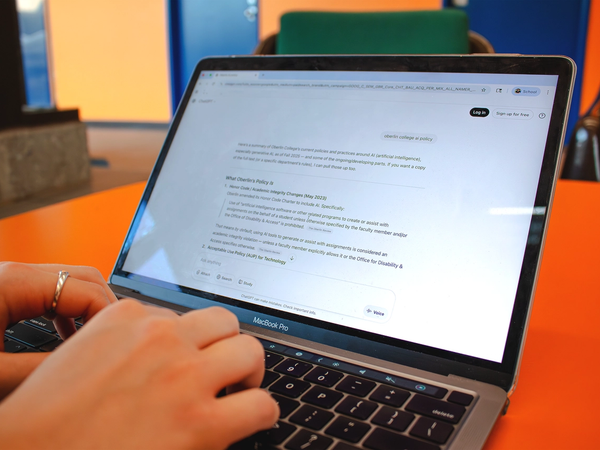
Though some professors do allow, or even encourage students to engage with AI in their classes, Oberlin's official Honor Code lists AI use as cheating.The code defines cheating as, quote, “when students do not do their own work in an academic exercise or assignment.” One of six examples of cheating listed is, quote, “Utilizing artificial intelligence software or other related programs to create or assist with assignments on the behalf of a student unless otherwise specified by the faculty member and/or the Office of Disability & Access.” So yeah, being encouraged to explore it is confusing.
But, even if there were some really valid downsides to AI use in academics, not all of the perspectives were completely negative. As stated in the Honor Code, AI use is permitted when allowed by the Office of Disability & Access, which can be a real positive.
INTERVIEWEE 8
I feel like it depends on what it's used for. I technically use AI in my note taking app to help me translate in class. It's really helpful, because it’s kind of hard sometimes trying to keep paying attention, especially with someone with ADHD, executive dysfunctioning, and other types of, um, accommodations.
AUGUST
There’s also some curiosity surrounding this exploration, albeit in this interview, mixed with a little apathy.
INTERVIEWEE 9
I don't really understand what it means to like, lead a campus wide exploration of how AI can help us as individuals. Like, I don't really know what that looks like. I am maybe interested to find out, but I don't, I don't really care all that much.
AUGUST
And to round out the positives, there’s proaction.
INTERVIEWEE 10
As someone who is studying to go to grad school, to then become a teacher, I think that it is, uh, inevitable that the world will be transformed and academics especially will be transformed by AI. I don't want this. I too am a creative, and also I'm just a person who lives in the world and I don't like the things that AI is being used for or the cost which it has on our planet and our society. I think regardless, we're going to see a lot of it. As someone who will have to deal with it in my classrooms in the future, I understand that there is a drive to use the things which are being built for us to use. And I don't know what’s President Ambar’s thing, but I hope that, you know, somewhere in there she is thinking about, oh, I want to do this and I want to do it responsibly.
I think that with all that in mind, there are certain lines which will be crossed and the face of academics will change for it. I think that the era of the essay is going to be over in the next five to ten years. I think that we are going to see a transition to a model of learning which is so much more centered on, uh, person to person and peer to peer, like Socratic experiences of learning. As AI takes over, we are going to have to sit in the rooms with each other, talking to a real person with real thoughts.
AUGUST
Regardless of the opinion, Oberlin students seem willing and able to have open, passionate conversations about AI use. If we move forward with this initiative, those conversations are integral to making sure we’re doing so in a productive and responsible way.
Sources:
https://news.mit.edu/2025/explained-generative-ai-environmental-impact-0117
https://www.oberlin.edu/president/statements-and-publications/year-ai-exploration-oberlin