Where We Used to Meet: Students on the Decline of Oberlin Third Spaces
2025-12-02T00:00:00.000Z
By Yrva Desormeaux, Riley Galpin, Isabella Moss
Is it not natural for a college or university campus to change over the years, and for multiple graduating classes to have differing experiences of what their time was like at the same institution? It is, but a wide range of our student body here at Oberlin College has a problem with just how fast our campus spaces are changing.
Yrva Desormeaux:
Is it not natural for a college or university campus to change over the years, and for multiple graduating classes to have differing experiences of what their time was like at the same institution? It is, but a wide range of our student body here at Oberlin College has a problem with just how fast our campus spaces are changing.
Since 2022, the administration has removed and consolidated several popular third spaces on campus despite student pushback. I'm Yrva Desormeaux
Riley Galpin:
I'm Riley Galpin, and we have pulled together a collection of students' testimonies on the differing campus experience for upperclassmen and underclassmen within the timeframe of 2022 to 2025. Along with input from the administration on what they have to say about balancing students' concerns and their obligations to the institution.
Yrva Desormeaux:
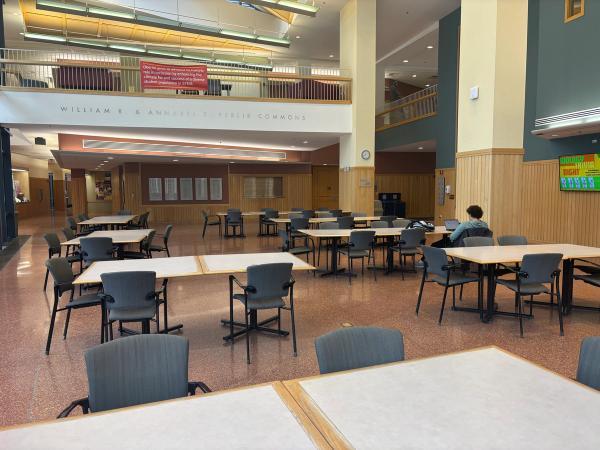
Third spaces are defined as informal, public gathering spaces that are separate from the home, the "first space" and work, "the second space." They are spaces where people can go and gather, socialize, exchange ideas, and build community. And with Oberlin being a rather small campus, there's only so many third spaces for students to go and hang out.
But every student has a story about their favorite one. Here's a few...
Lily Hessekiel:
Either Tank or the Hark lounges. I have built so many memories there. Just like I've made my network of friends there, I've had good meals. I've felt like I'm at home more than I'm at school there.
Kaylee Johnson:
I live in Kahn and on the third floor and there's a space there and we hang out every single night there. We watch movies, we play games. It's how I met like most of my friends. It's probably my favorite space.
Isabella Moss:
I feel like honestly, Mudd first floor, I've really gotten into like working in kind of Azzie's and just like the first floor of Mudd. I feel like it's so awesome to have friends come up to me or walk in there and find friends and just be able to like talk to people.
Ilan Kahanov:
I'll say Azzie's. It allows for that like complete range of human interaction of like, you can sit quietly, be on top of your work and all your business. But like you can also just like sit there and drink coffee and like wait for your friend to show up for like per chance.
Yrva Desormeaux:
But some of these spaces among others have been removed or condensed, like the removal of all seating in The Rathskellar, aka, The Rat, and the reduction of partial seating in Azariah's Cafe, aka Azzie's to make room for the relocation of the campus bookstore. Or the complete closure of Biggs GoYeo, the old smoothie bar in late 2023.
This creates a gap in campus culture for some of the underclassmen, leading some with unmet expectations of what spaces they hope to find here at Oberlin.
Isabella Moss:
I definitely expected more. I feel like, a big part of me deciding to come here was reading the, a hundred reasons to come to Oberlin and getting really excited and I think a lot of them felt very community oriented. But yeah when I actually got here I was like oh, we don't have access to spaces 24/7. And there aren't that many communal spaces and a lot of them are revolved around academics. I do mourn the fact that like students five years ago seem to have had more third spaces.
Yrva Desormeaux:
To get the other point of view, we asked upperclassmen how the four year experience has been affected by the constant changes in campus third spaces.
Ilan Kahanov:
It's really sad. Where the bookstore is now, when you walk in this right side like that wall used to be like a 20 foot bench tables broken up and then like chairs on the other side. And like, you could get like a whole friend group in there. You keep seeing people and you keep adding on and like filling in and like it becomes like completely different time.
And I don't see anybody do that. You can't fit more than like three, four people in the booth. I don't know, let me talk about my fears about graduating and all these other things with like my peers in these spaces. But like, they are diminishing.
Lily Hessekiel: Someone wrote a Grape article recently about , if you're just sitting in a Wilder and someone comes and sits across from you, like, how would you react to that?
Or would you ever do that? And I think that that's something that like you would expect to just be around someone more often where you're in close contact and you just start up a conversation. Most of the responses to that were like, "I would be super uncomfortable if someone did that to me." And I think that's something, because we're not used to being in third public spaces with other people where you would just be open to have a conversation.
Riley Galpin:
Aside from the removal of campus, third spaces, external factors are also affecting interactions and the ability to congregate in said spaces. These factors include the delayed construction on Wilder Hall and the change to mobile ordering across all campus grab and go dining options.
Ilan Kahanov:
This is like a social issue of like say thank you to the people working at Umami. Just cause you pressed a button on your phone and all of a sudden the food is there.
It's like a human being did that, you know? Like it does kill me that , I'll see people go in there and sort of parse through whatever is on the table and then just like kind of put their head down and leave and it's like. You see the guy Thian with his manbun just like giving you a thumbs up and, they don't even tune in.
I think the whole thing is just less personal, and so you don't interact with the workers, but then, that leads you to not interact with anyone. Like you're not even thinking about human interaction. You come into Azzie's, you go to a shelf and pick something up off of it and leave. That in and of itself doesn't encourage people to use the spaces.
Lily Hessekiel:
I rarely go to Wilder 'cause I can't get anything from DeCafe or The Rat. And theoretically I could go there to use it as a third space and just hang out, but it's not constructed in a way that makes that feel welcoming. It smells bad. The furniture is not comfortable. Like it's not a space that is ideal for, using as a third space.
Riley Galpin:
While third spaces dwindle and their quality worsen the topic of dorm lounges as an alternative comes up. But the consensus on whether they're fit to foster campus community is split. While they do have a bit of a come and go nature, they also provide a good spot for established groups to hang out.
Lily Hessekiel:
I think OSCA just kind of does it differently where it emphasizes that as a benefit and not just an option.
Yrva Desormeaux:
OSCA, short for Oberlin Student Cooperative Association is a student run non-profit corporation that houses and feeds several of Oberlin students. It is a low cost alternative to the college's traditional dorm halls and meal plans. The built-in community aspect is a major selling point for many of those who join.
Lily Hessekiel:
In OSCA, I think because it's linked with use, like you are always going to eat in the lounge or the dining space , so you're comfortable being in that space. The highlight of OSCA is the community and so putting yourself out there for the community in a space where like, you may not know everyone, but you know, everyone is open to having conversation or you have something in common, which is your co-op that is more approachable.
Ilan Kahanov:
I don't live in the dorms anymore. But there were a lot of times where like I didn't have anything to do so like, I would just like go to the South lounge and my best friend would like walk through doing his laundry and next thing you know, like we're talking for three hours in the lounge.
Now that I don't live in a dorm, the last thing I want to do is go sit in like the South lounge and like wait for someone I know to up and appear.
Riley Galpin:
Still, even dorm common rooms aren't safe. From the trend of declining third spaces at Oberlin. With dorm buildings like Dascomb Hall repurposing past common spaces into more double and triple dorm rooms to accommodate the Office of Admissions past problems with continuous overenrollment.
But when looking at the big picture outside of just personal experiences, there's a discussion going around about how vital a role third spaces play for a college's campus culture.
Isabella Moss:
It's so unhealthy for someone to just be like constantly asked to make themselves available, to like do work, to be participating in events and activities. Not that those things aren't good, but I think that these common spaces really help people find a balance between like social life and academic life. I think that's a really important thing.
Ilan Kahanov:
I, I think that like the beauty of a third space, if you will, is the like lack of expectation. You're allowed to just occupy the space. That is hard to come by , and I think if you set that intention, people will use it for productive things. People will use it for like real social engagement. It, it's the freedom to be if you will.
Lily Hessekiel:
I mean they're important because I think what I was talking about earlier with like, you expect to be able to just go up to talk to people and like that's how you make friends. It's how you expand your social circle, but also your worldview and your experiences and your career opportunities is by talking to people. And a third space is a place where you can do that, that's less scary and can be less serious and can kind of happen by chance more than like being in a space for a specific purpose.
Yrva Desormeaux:
So far, we have shown just how much students care about our third spaces, but what exactly are students doing to make it known to the administration that they care about the decline of third spaces at Oberlin. Since 2023 seven articles relating to the removal of campus third spaces, the social impact of the change to mobile, and the renovation at Wilder Hall have been written in the Oberlin Review. One of the campus's most well-known student-run newspapers.
One of those articles was written by Ilan Kahanov, who have you heard spoken several times throughout this piece already. The article focused specifically on Azzie's and the continual erosion of student community. We were able to gain insight about their efforts to advocate for student spaces, both inside and outside the range of the article. Including how this issue has affected WOBC, Oberlin's student run freeform community radio station, which formally operated out of Wilder Hall before construction. Kahanov is WOBC's station manager.
Ilan Kahanov:
Yeah, the article was big for me. I also just like generally wanted to write for The Review before I graduate. I tried to get like a little petition going and I talked to Thom Julien, who's like the radio faculty advisor and Associate Dean of Student Life. Tied to that, I was sending emails to the Office of the President in like library, and they would just forward it to Thom Julien and be like, "Can you solve this?" And so I met with him and we talked about it and he was like "The college is pretty like immovable on this. Like they've made this decision. They think this is financially responsible.." like with Azzie's specifically. "And they're like not willing to compromise."
I spoke to, the head librarian, Valerie Hotchkiss she's pissed. But she's like, "I have no idea why you guys did this." Um, I tried for that. I have been up facilities, but about the construction timelines. There's a ton of like money issues on like where it's coming from, when they're gonna spend what money and what part of the building. So I've been kind of hounding them of like can we get any sort of like estimate. Even just for like when you're gonna do this floor, when you're gonna do this room. But like, they don't recognize like that this is putting a, a damper on students' lives.
Like I'm obviously coming to them through the lens of like WOBC. Like we're losing our sort of radio community and like ability to function in certain ways, but like that extends beyond the radio. Like student orgs will use the space, friend groups will use the space. And then socially it like has certain standing, but like they won't, we don't know what's going on.
Yrva Desormeaux:
Outside of just individual student efforts, there have also been student orgs that have taken a stand against the decline of third spaces on campus. After the college's announcement of the relocation of the bookstore into Azzie's, the Oberlin chapter of Young Democratic Associates of America, aka YDSA, led a sit-in on the floor of Azzie's in May of 2025, the sit-in was covered in one of the affirmation Oberlin Review articles.
YDSA members and organizers of the sit-in as Ezra Rudensky and Keni Maberry were quoted by the author Sylvia Ewart saying "That the Azzie's situation is emblematic of a longer trend of Oberlin taking away communal spaces. And students need to remember that their voices can make a difference if they choose to use them for things they care about."
While the voices of student concerns are abundant on this issue, the administration has remained firm on their choices to remodel and remove past third spaces, citing things like the need for office space for Residence Life, And the reason behind the closure of Biggs GoYeo and the need for more storage space in The Rat as the reason for the complete removal of its dining area. Along with the change in partnerships from Barnes and Noble to eCampus.com and University Gear Shop for the relocation of the bookstore.
But the big issue with these changes is whether or not students were consulted during the decision process. Via email, we interviewed two administrators on this. Mark Zeno, the Assistant Vice President and Dean of Resident Life and Auxiliary Services. And Thom Julien, the Senior Associate Dean of Students.
When asked about whether or not there was student input on the reconstruction of Azzie's to include the bookstore, Thom Julien stated:
“Students both through Student Senate and individual focus groups were consulted on the reconfiguration of spaces to best meet their needs and the utilization of space on campus."
Although it was not made very clear what kind of students these focus groups consisted of and how exactly they were assembled, still Julien continued with:
"Oberlin is a community that thrives on involving the voices of students, faculty, staff, and community members together. We will continue to prioritize involving all of our community members in decision making."
Riley Galpin:
To see how deep their consideration of student input went. We spoke with Gideon Hurtado-Sher, who is Student Senate's current Vice President of Student Life. She was able to give us insight on how the administration came to them regarding the removal of Azzie's seating.
Gideon Hurtado-Sher:
Senate sat in on a couple of the meetings at the very end of last year when Azzie's seating, was rumored to be changing, we weren't really sure what the final product was going to look like. The past president and I did see a blueprint, but at the time, like they had already, drawn up the blueprint, so there wasn't really anything we could have said that would've changed the final decision.
I do feel a little disappointed that we weren't able to have more of an impact on the final decision, but I do think that they did make an effort to at least let students know what was going on. I don't think that they were necessarily trying to hide the decision.
Riley Galpin:
To get a greater idea of how concerned the administration was about replacing past third spaces, we asked if they had any plans to create new or redesign current third spaces in the near future. Along with what criteria would guide the creation of those spaces, and how could students be meaningfully involved in shaping those decisions. But we were not met with a response.
We also asked Hurtado-Sher if Student Senate shared the wider student body's concern about the loss of third spaces, and this is what she had to say about it.
Gideon Hurtado-Sher:
I think that it's really valid to be concerned because third spaces are part of what keep our campus community connected to each other. It's definitely an opportunity to meet new people. I do think that once Wilder is renovated, they're currently working on the third floor, they will eventually work on the second floor.
There should be room for more community space. Once those, um rooms are back online and so , there will be increased availability of public spaces. It's just going to take some time because renovation takes some time, and I know that can definitely be annoying for upperclassmen who won't necessarily get to enjoy those spaces.
Yrva Desormeaux:
Even with the extent at which the administration has currently acknowledged student input, we must recognize the issue of institutional obligations they may have to focus on above student wants, along with how they assess those student wants while balancing set obligations.
In regards to assessing student wants, Mark Zeno described how Residence Life handles it, saying:
"We use a variety of surveys both from AVI and Oberlin, including the use of the Dining Advisory Committee and other input from students and stakeholders. AVI surveys go out two times a year and housing surveys go out once a year. We are currently working on a mid-year survey with the Center of Student Successes' assessment team."
“Additionally, we are exploring the creation of a Housing Advisory Committee similar to that of the Dining Advisory Committee (made up of two class representatives, faculty and other employees) where feedback and ideas are discussed to improve housing for students at Oberlin."
On balancing institutional priorities Zeno further said:
"From the Residence Hall standpoint, we have meetings to discuss the Housing Master Plan for improving student housing on campus. This preliminary plan outlines renovation for current structures, replacement of older structures, that could be replaced with improved housing types, and exploring additional updates to housing like new furnishing. These are discussed biweekly with Facility Operations, and we include our Student Senate Housing/Dining Rep as well."
Riley Galpin:
Even after considering the reasons and obligations the administration have, students still feel their expectations should be acknowledged. Their view on campus third spaces remain strong as many of them provide relief from and aid in their academics. The students we interviewed even had some of their own visions of what kinds of spaces if created, would best serve the student body.
Lily Hessekiel:
I think primarily getting rid of all the mobile ordering and putting back seating in various spaces. Like The Rat, like Azzie's , maybe even DeCafe. Recognizing where students congregate and emphasizing that rather than trying to impose an agenda. For what they think is what we want or need.
Isabella Moss:
I do feel like art students need more of a space than just their respective studios or theaters, and whatnot. But I also think , like the bookstore could have been turned into like a really nice kind of hub for artists.
Ilan Kahanov:
This is maybe a pipe dream, but like you know about the like year 2000, like LAN parties? Where everybody had like an old like desktop computer and they were all plugged into each other. Like, it'd be fun if we kind of had a space like that, which I guess Mudd is a little bit. Um, I don't know there how many classrooms and Severance don't ever get scheduled? Like throw a bean bag chair in there or something.
You know what I mean? Like maybe there's a way to sprinkle like. Almost these like dorm lounge adjacent vibes into more public spaces. Maybe take some inspiration from the cozier setups they're trying to provide and put those in like all student public spaces.
Riley Galpin:
Despite numerous imaginative and restorative ideas from students on what spaces they would like to see come to life, it is sad to see that many aren't hopeful about the possibility of the administration actually considering them.
Lily Hessekiel:
Yeah, I mean, I've seen protests, I've seen like signatures. I've seen every form of dissent that I could imagine or that is normally practiced and they don't recognize that.
Ilan Kahanov:
I think it will be very hard to like, push them to do these types of things. I don't know, it's a bit disheartening for me to like, hear and experience how they like use their money.
Like I understand an endowment is not just like you have the money, you can spend it however you want. There's like certain things it's for, but like how many times do they put "community building" in an email or like Campus Digest and there's like nowhere to like actually do it .
Yrva Desormeaux:
Hopefully at this point we have conveyed that the decline of third spaces at Oberlin is more than just the loss of seating at a cafe or less spaces to sit down and talk with a friend. It is indicative of a greater erosion of informal gathering spaces that foster belonging and community, for a vast range of our student body.
It demonstrates how administrative decisions can ripple into student life shaping not only where students meet, but how they see themselves as a part of Oberlin's community. If the college wants to cultivate a strong sense of inclusion, solidarity, and community among their overall campus, they must recognize that third spaces are not a luxury, but instead a foundation for belonging.
We need spaces that honor student voices, foster wider connections and affirm that a college experience is more than just lecture halls and dormitories, but also the shared common spaces between them.
This project was made by Riley Galpin and Yrva Desormeaux Thank you to the following interviewees in order of speech and mention:
Lily Hessekiel, Kaylee Johnson, Isabella Moss, Ilan Kahanov.
Assistant Vice President and Dean of Residence Life and Auxiliary Services, Mark Zeno. Senior Associate Dean of Students, Thom Julian.
Student Senate Vice President of Student Life, Gideon Hurtado-Sher.
Music by bzur.
Music: Driving My Car (No Vocal) by bzur (provide by Descript)
Articles Mentioned & Consulted During Research
Benhur Mosazghi Ghezehey. “Homage to Cafés in Search of Third Places.” The Oberlin Review, 2024, oberlinreview.org/31841/opinions/homage-to-cafes-in-search-of-third-places/
Bouknight, Daisha. “Disorganization in Housing Process Contributes to Lack of Community.” The Oberlin Review, 2023, oberlinreview.org/31719/opinions/disorganization-in-housing-process-contributes-to-lack-of-community/
Brunk, Skylar. “Floor Collapse during Renovations Disrupts Student Orgs in Wilder.” The Oberlin Review, 2025, oberlinreview.org/35591/news/floor-collapse-during-renovations-disrupts-student-orgs-in-wilder/
Ewart, Sylvia. “Students Led Sit in at Azariah’s Café for Preservation of Communal Spaces.” The Oberlin Review, 2019, oberlinreview.org/35303/news/students-led-sit-in-at-azariahs-cafe-for-preservation-of-communal-spaces/
Ilan Kahanov. “Death of Azariah’s Symptomatic of Continual Erosion of Oberlin’s Student Community.” The Oberlin Review, 2019, oberlinreview.org/35838/opinions/death-of-azariahs-symptomatic-of-continual-erosion-of-oberlins-student-community/
Manning, Stephanie . “New Campus Store Opens at the Heart of Campus | Oberlin College and Conservatory.” Oberlin.edu, 4 Sept. 2025, www.oberlin.edu/news/new-campus-store-opens-heart-campus.
Nobel, Lily. “Stalled Renovations in Wilder Limit Student Organizations.” The Oberlin Review, 2025, oberlinreview.org/35068/news/stalled-renovations-in-wilder-limit-student-organizations/
Oberlin Office of Communications. “Oberlin to Launch Online Bookstore, Reenvisioned Campus Shop | Oberlin College and Conservatory.” Oberlin.edu, 1 May 2025, www.oberlin.edu/news/oberlin-launch-online-bookstore-reenvisioned-campus-shop.
Pearson, Claire. “Bookstore Relocation Threatens Campus Culture.” The Oberlin Review, 2025, oberlinreview.org/35260/opinions/bookstore-relocation-threatens-campus-culture/
Roberts , Ariel . “A Love Letter to Biggs GoYeo.” Oberlin Blogs, 19 Dec. 2022, www.oberlin.edu/blogs/love-letter-biggs-goyeo.
Sato, Adrienne. “AVI Updates Student Meal Plans, Ordering Systems, Dining Halls.” The Oberlin Review, 2023, oberlinreview.org/30695/news/avi-updates-student-meal-plans-ordering-systems-dining-halls/