The Reality of AI at Oberlin
2025-12-02T00:00:00.000Z
By August Butler, Isabella Moss, Dru Bramblett
Oberlin’s administration launched a “Year of AI Exploration Initiative” at the beginning of the Fall 2025 semester, and the contradictions in its proposal, philosophy, and implementation raise questions about its true motivations and goals. This episode asks and answers the question, “what is this program doing to fulfill student needs?” With insight from leaders within the initiative and members of the environmental studies program, we uncover the real role and reception of AI at Oberlin.
BUTLER: On September 3rd, 2025, a letter from Oberlin College President Carmen Twillie Ambar was released, announcing and explaining the 2025-26 “Year of AI Exploration Initiative.” Through it, our community will experience a transformative year at Oberlin where the entire campus comes together to unlock the power, creativity, and future-shaping possibilities of AI—while staying true to the values that make Oberlin extraordinary.
Or at least, that’s what ChatGPT tells you when you give it the link to the letter and tell it to sell ya. I’m obsessed with saying we’re gonna “unlock the power” of a chat bot, that’s hilarious. But it’s weirdly not that far off from the tone of Ambar’s letter, considering clarity. Just in this one document, without even looking at what’s happened with the program since, the Initiative contradicts itself constantly. The letter sometimes expresses how aware and grounded they are in taking this on, saying that, quote, “our goal is to create a space, beyond the noise, hype, and fear, where we can think critically and creatively about what AI means for our students.” But also kicks off by saying AI is, quote “transformational and possibly revolutionary,” mimicking that noise, hype, and fear exactly. Now, I’m not claiming it was written by AI, even if it really milks the em-dash, but ChatGPT has a reputation for making everything feel extraordinary, while also empty. And this Initiative, as proposed, has the same feeling. This is August Butler,
BRAMBLETT: Dru Bramblett,
MOSS: And Isabella Moss,
BUTLER: And since the initiative was first released, there’s this illusion that there’s something solid holding it up. But the second we pressed down on it, the cracks started to show. It feels like Oberlin’s administration, at least Ambar and her office, are really big fans of AI and “harnessing this technology,” another direct quote from the letter, while also gesturing toward the horrible attributes of AI and saying “yeah, and also, we can talk about that too.”
MOSS: A lot of what’s happened since the announcement seems like an afterthought. While the Fall 2025 semester has been about faculty and AI, they’re turning their attention to students in Spring 2026.
BRAMBLETT: They want to make students quote, “critical thinkers, culturally competent, and prepared to meet the challenges of the world we will inherit,” which, to them, includes providing all of us with access to paid ChatGPT accounts.
BUTLER: This is our education, and we deserve to know if this is going to meet our needs as students.
MOSS: AI’s being talked about in the Initiative as if it’s been completely ignored at Oberlin since its creation. But Valerie Hotchkiss, the Azariah Smith Root Director of libraries, has a different story.
Hotchkiss: The last three years have been years of exploration for all information and library scientists.
BUTLER: But they weren’t involved in the program from the start.
Hotchkiss: Libraries were not involved in the decision, but got involved in the implementation of it pretty quickly because we already were studying it as librarians and we already were teaching it to students. So we just kind of told ‘em what we’re doing and suddenly we're a main prong of the year of exploration. So it's nothing new to us, but we were gratified to see that the campus itself would begin to look at it and all the ramifications. That’s all we talk about, is AI, these days in library world. AI is, at this point, a glorified way of searching the internet. And I think this is very unclear to a lot of people. They think, ChatGPT, they’re doing research.
BUTLER: Hotchkiss explained that the lack of peer reviewed, trustworthy sources AI can access, paired with how frequently it makes up information, AKA hallucinates, means that it isn’t at all a source for academic research.
Hothkiss: So we worry as librarians, we worry a lot about that. I think we need to teach students, and that's what we're trying to do and have been, teach students how to use it effectively.
MOSS: The Oberlin Group of library directors, named for its founding at Oberlin, is a congregation of 88 small liberal arts colleges’ libraries. They’ve been discussing AI for a long time. She told us about one library director’s methods of AI implementation.
Hotchkiss: He takes a finite body of information, a corpus, for every class at their little school. That’s AI. So he builds a little chat bot, so that they have all their assignments in there, all their readings are in there, and then students can just ask a question. But do you really wanna do that? Or do you want students to think for themselves?
BUTLER: She described this problem as “cognitive offloading,” which isn’t a phenomenon unique to AI. It’s defined in a 2016 article by Evan Risko and Sam Gilbert as “the use of physical action to alter the information processing requirements of a task so as to reduce cognitive demand,” which is AI’s purpose. The example that Risko and Gilbert used in 2016 was that the use of the GPS will reduce our internal spatial awareness, memory, and ability to follow directions, which, quote, “will in turn increase the likelihood that we choose to rely on the external artefact in the future.” Which has absolutely happened with the GPS. But the issue a lot of people see with AI and cognitive offloading isn’t the same as the GPS or digital clock or stand mixer, because losing the ability to tell what time the little hand is on or beat an egg won’t really have any lasting impact on us. But the purpose of academics is to develop cognitive skills, and offloading that would mean it wouldn’t happen. That’s a huge reason why AI in academics is so scary.
MOSS: Another really scary element of AI, which Hotchkiss also mentioned, is its environmental impact. We talked to a member of The Oberlin Eco Reps, a program that works with the Office of Energy Sustainability, or OES. They’re also looking further into getting as much information as possible about AI into the hands of students. Isabel Hyman, now a fourth year, helped create the Eco Reps in her first year.
Hyman: I worked with Heather Adelman in OES to create the program. We really focus on behavior change.
MOSS: A lot of people aren’t really aware of the full scope of AI’s environmental impact, and the Eco Reps believe that educating them is important to allow them to make informed decisions about AI.
Hyman: Data centers use an insane amount of energy. Enough to power a hundred-something homes. I don't know the exact numbers, so I'm not gonna say them.
BUTLER: I’ll say them. A Pew Research Center article published October 24th, 2025 says that, quote, “a typical AI-focused hyperscaler,” which is a warehouse-sized data facility, “annually consumes as much electricity as 100,000 households. The larger ones currently under construction are expected to use 20 times as much.” These centers also cause intense noise pollution, as well as massively raise electricity costs by up to 267%, according to an October 25th, 2025 article released by BBC.
Quoting an article published by MIT, “many buildings use millions of gallons of water (often fresh, potable water) per day in their cooling operations.”
Hyman: If we are going to start using AI, it kind of calls into question how we can be carbon neutral. We just achieved that this past spring, it was a big deal and it's really awesome, but I think the office is still working to figure out where that impact would be, and if it would legally affect our carbon neutrality. But, I think regardless, morally it does. We're not trying to push people away from it, because I can understand why people think it is very, very helpful. I think it should be a campus discussion on how to use it morally and ethically. It's important to not just rush into using it and make sure that everyone has the knowledge to make decisions for themselves. Maybe this year of AI exploration could slow down, and give people time and get more student input, and make it kind of a big deal.
BUTLER: As the pieces of the puzzle are coming together, there’s a pretty clear picture being painted of a program that didn’t seek the input of the people it’d be impacting. And, surprisingly, that isn’t even speculation. In Ambar’s letter, she says, quote, “Over the summer, I have been consulting with a small group of advisors from the deans’ offices, key faculty members, administrative leadership, and the Center for Information Technology.” Joe Lubben is a vital member of the Initiative as the Conservatory Director of AI Strategy and Innovation, the counterpart of Adam Eck, who serves the same role in the college. Lubben and Eck were the only two people mentioned in Ambar’s letter. They are leading the Initiative. So we asked Lubben how the initiative came to be, because he must know, right? And we listened as one of the leaders told us that he wasn’t even in that initially consulted group.
Lubben: To answer that question authoritatively, you would have to probably ask the president and her leadership team. Because work was done over the summer. I was brought into the process in August.
BRAMBLETT: So, he wasn’t involved. Scratch that question. What’s happening now? Lubben told us that he works with Eck, along with various Deans and faculty members, both in academics and administration.
Lubben: We are, as a group, trying to help the president really shape this initiative. Gathering faculty opinions, helping to organize training. We are not in the business right now of shaping policy. We’re more about exploring, gathering, getting feedback, and organizing things.
Bramblett: So, what would you say the primary goal of the initiative is?
Lubben: You can look at the president's initial mission statement. I think she had five, or maybe six, I should remember exact points about it.
BUTLER: We did look. There are six listed goals, and each of them can really fall into one of two categories: increasing AI use, or discussing the issues with increased AI use. Issues that are described very, very vaguely, such as, quote “the concerns that AI raises in faculty research and pedagogy, student learning, ethical and privacy matters, environmental considerations, etc,” the letter literally says etcetera, I’m not adding that. They want to ensure that, “yeah, we get AI is harmful,” but also they think it’s good, and also unavoidable, and so we have to use it, but also not use it the wrong way. It’s a theoretical conundrum, and the initiative is, at its core, bringing the hot mess to life.
Lubben: Essentially it's trying to help shape what is Oberlin's identity and institutional role in being a part of that world. Figuring out what Oberlin's real position is and how we're going to navigate this.
BRAMBLETT: The faculty have access to a 30-day self-study program from Oberlin’s Center for Information Technology, as well as a speaker series where educators that have a better understanding of AI would present their findings. Lubben said that, at trainings provided for faculty on how to use AI in the classroom, attendance has been low. They’d planned that only faculty and staff would receive these resources in Fall of 2025.
Lubben: And that sometime in the Spring, without a clear date in mind, that there would be more of us activating these tools for students.
BUTLER: So, there are a few things this tells us. The first is that Oberlin will provide ChatGPT accounts to students, alongside training events. But if similar events had low attendance from faculty, it wouldn’t be a stretch to assume students aren’t gonna show up either. It also tells us that upon the initiative’s creation, there wasn’t a clear plan about how this would benefit students, and now, less than two months away from Spring semester, there still isn’t a plan nailed down. And yet, students will be given access to Open AI products in Spring, before we’re given any of the education on how to use them.
Sorry, let me rephrase that: They have paid Open AI, a huge, destructive company, however much money, probably a good amount, so that we can have uneducated access to a service that, based on the honor code, we would often be cheating by using. (The cheating thing is a whole other topic that we’re not really gonna get into because this podcast would be an hour long, but the gist is that it’s up to professors to choose whether AI is allowed in their classes, anyway,) A service that, based on the surveys they did at the beginning of the school year, the vast majority of students weren’t using already, and do not want.
Lubben: Surveys of faculty in the college, faculty in the conservatory, the administrative staff, and then a student survey as well. Next week there will be a student senate sponsored forum. They’ve invited some of us to speak at it.
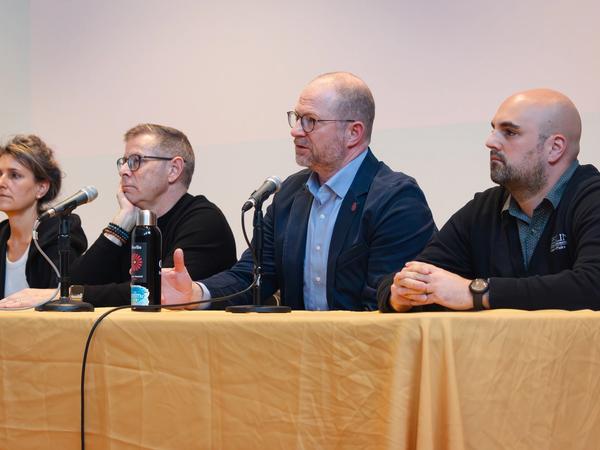
BUTLER: If you missed the event, we’ll give you the scoop. It’s rapidfire statistics time. In the presentation, they gave the results of the survey Lubben referenced. It was responded to by 848 students. According to the 2024-25 data available on Oberlin’s website, there were 2,886 undergraduates enrolled. So we can approximate that about 29% of students responded, a solid portion, and those students were described as being from an even divide of class years and a spectrum of different academic fields. Students reported a much lower percentage of AI use than national data, which said that 90% of college students use AI. At Oberlin, 10% said they use it often, 55% of students said they never use it, and 64% said they feel uncomfortable using AI.
Lubben: I think in general, the Oberlin faculty, at the announcement of this process, were highly suspicious and reluctant, much like the Oberlin student population. And I would say part of my job has been to reassure people. Students, I think that's more of a work in progress, but there hasn't been as much of an effort or communication. So I think that's where more of our attention will be turned as we move through Winter Term and the next semester.
Bramblett: And so by the end of this year, what do you hope that the outcome is gonna be?
Lubben: I think the end of this year is too early to set a real outcome. Just that we have… learned something, right?
BUTLER: So… it’s not a year of AI exploration. Even though Ambar’s September letter directly says it’ll happen “Over the next nine months,” that’s no longer the case. Everything we’ve learned feels like it was made up on the spot. Except for one new feature of AI at Oberlin.
Lubben: I didn't mention it because I'm not working closely on it, but it was just approved, a minor in critical AI studies in the college.
BUTLER: So, a Critical AI Studies minor has been approved. The gut reaction, for us at least, was “what is that?” But we wanted to give it the benefit of the doubt.
BRAMBLETT: To get some more information on the AI minor, we talked to Nick Anderman, a visiting professor of Environmental Studies in his first semester at Oberlin.
Anderman: I've been a part of the faculty committee that's been developing the critical AI studies minor which is gonna be a new minor that's launched on campus next year. We've been meeting once a week or so all semester to come up with this, and it was approved by the college faculty this week.
BUTLER: The week of November 15th, 2025.
Anderman: The purpose of the minor is not to hype AI or push AI, it's actually quite the opposite, right? It's called a critical AI studies minor because it's meant to give students the tools to engage with AI intellectually, not materially by using the products. Good critique, that’s what the liberal arts are all about. And I want students to be able to critique very specific parts of what AI is. And be able to see through the hype, basically. The ideal sort of student for this program is someone who's deeply skeptical of AI on the verge of never wanting to ever engage with it. I've been told that they will not actually be using AI to do anything, but they will learn about the basics of how it works. I study specifically labor and the relationship between labor and the environment. And ai, of course, was devised maybe most directly to impact labor to steal jobs from people, my hope is that the minor will communicate that. Land, energy, water, labor, that is what AI is at some level. It's an extractive relationship to those things, basically. I guess the elephant in the room, as it were, is the open AI contract that the college struck. Most of the faculty and students that I meet, at least, and I am coming from a very particular part of the college, they don't want access to AI and they wish that was not a part of this year of AI exploration. I'll say this clearly, right? I don't like that the college paid a lot of money to Open AI. A company that, at the beginning, they were very concerned about the potential long-term, like catastrophic effects of AI. And now they seem to be pulling back from that in an effort to monetize their product. So I wish that we hadn't paid money to that company.
BUTLER: It’s easy to lose faith in our school’s approach because of it. But Anderman, while acknowledging that AI can often feel like an overblown fad, knows that AI’s impact is real. What he said to that effect kind of gave us hope.
Anderman: I think the metaphor is like, oil, maybe. I don't like the oil industry. But I think we need to pay attention to it and study it, and people do, right? There's like a large academic group of researchers who are focused explicitly on various aspects of the oil industry around the world, right? I feel like AI is similar. It needs to be studied and critiqued knowledgeably.
BUTLER: That should be the perspective moving forward. Not that AI is a magical, mystical tech that needs to be embraced academically, but that it’s a big, harmful industry, and we have an amazing student body that’s capable of studying and understanding it objectively.
MOSS: Funnily enough, Anderman basically said what led us to be interested in this program to begin with.
Anderman: The year of AI exploration is a big and complicated program with many moving parts, some of which directly contradict one another.
MOSS: That is true. But the complexity of the program, in some ways, is smoke and mirrors.
BRAMBLETT: Even with all of our research and conversations, there’s probably more going on behind the scenes than we know. The amount of improvising they’ve done recently is evidence of that. But the surface level product of the initiative is actually much less complicated than it needs to be. Our slightly unsolicited advice is that they should go further in their consultation of students. Diverse students, from all departments, backgrounds, AI experience, and opinions. Make sure they’re educated, and see what they say. Because what we’ve seen in all of our conversations, questions, and research, is that we need a better through line between the people creating this Initiative, and those actually being impacted by it.
BUTLER: With all of this information, we have a good understanding of whether this is being done for the collective benefit of our community. We believe that the new critical AI minor will meet the needs of the students and faculty, because it’s engaging with AI consciously and considerately as a larger issue, rather than an amazing new tool. We also believe that the basic Initiative, when it’s opened up to students in Spring, will not meet those needs, and needs to be slowed down.
Music by August Butler
Sound sourced from Adobe Stock
Special thanks to Ben Logan