Labor and Unions at Oberlin
2025-12-02T00:00:00.000Z
By Lily Thorton, Ben Giesen
Two Oberlin students look into the administration's attitude towards unionized labor and how it has developed over the last five years.
LILY
On February 19th, 2020, one third of Oberlin College's students flooded into the King Memorial building. There were so many people that they spilled onto other floors and filled the stairways. There was a protest that day, specifically regarding the lay-offs of more than 100 workers at the college. At the time, the press coverage was huge. We’re here in 2025 to continue the story, and ask, how is Oberlin’s relationship to labor and unions now?
BEN
Since its founding in 1833, Oberlin College has built a reputation as a leading advocate for progressive thinking in the world of higher academia. According to the mission statement on the Colleges Website, “Oberlin… seeks to offer a diverse and inclusive residential learning environment encouraging a free and respectful exchange of ideas and shares an enduring commitment to a sustainable and just society.” While there are many elements of the college's history that support this narrative, certain actions taken by the administration in recent years have raised serious questions about the authenticity of this motto.
An especially divisive point of tension between the college's administration and its community has been the institution’s treatment of unionized labor. Although this tension has emerged in the student-admin discourse many times, several key events in the last five years have shown why this topic is especially relevant to the current generation of Oberlin students.
Music
BEN
Hi my name is Ben
LILY
and my name is Lily or Gabriel
LILY
Today we are going to talk about the Oberlin administration and their relationship with unionized labor.
Music plays
BACKGROUND RESEARCH/CONTEXT
LILY
In February of 2020, both students and staff at Oberlin were surprised to learn that the board of trustees had made plans to fire 108 dining and custodial workers. This came after the expiration of their contract in September. As part of the “One Oberlin” Initiative, this decision was one of several that aimed to reduce the college's spending on dining, sanitation, housing, and facilities operations. This cutback in particular would save the college $2 million annually according to an email sent by president Carmen Twillie Ambar.
A 2020 article uploaded to Jacobin by Oberlin alumnus Cameron Avery and Matt Kinsella-Walsh makes a very interesting observation about this email. They claim that the $2 million dollars that Ambar mentioned closely matches the cumulative cost of the 108 employee’s benefit packages. That’s an expense that Oberlin is not responsible for now that they’ve switched to a private contractor. As crucial as it is to ensure that Oberlin’s budget is being managed efficiently, it is equally as important that cutbacks occur in the right places, something that several community members say was not happening.
This is a school with a big history of activism, so naturally, this threat to the livelihood of over 100 employees was not taken lightly. This is how we ended up with 800 students protesting in the halls of King in February of 2020. The Spectre, a discontinued student publication, reports that protesters chanted slogans like “union busting is disgusting" as the General Faculty Council meeting took place close by. However, as witnesses from inside of the meeting confirmed, a majority of the council members still affirmed the cutback while a small handful including president Ambar chose to abstain.
LILY
We got in contact with a past organizer with the Student Labor Action Coalition, thats SLAC, named Elsa. They requested we don’t post their real voice, but here is what they had to say in regards to the fight,
BEN
“...I've never sat down with Carmen Amber, [I’ve] never sat down with any of the Board of Trustees. I don't know what intentions are in their hearts. I don't believe that they are necessarily evil or ill intentioned people who don't give a shit about the impact of their actions. …It mostly kind of seemed to them like they didn't really care what we had to say as students or…they didn't really care what labor had to say.”
LILY
As the logistical impacts of COVID-19 began to hit in the following months, union negotiations transitioned to a virtual format. Elsa said this impacted students' ability to respond. “We lost basically all of our momentum and all of our power.”
BEN
On August 3rd after many months of back-and-forth proposals between the college and United Auto Workers union representatives, an agreement was finally reached. The final contract said that if the union withdrew an unfair labor practices charge, something they filed with the National Labor Relations Board, the college would provide a severance package. According to a bulletin on the Oberlin human resources web page, this package included 3 months of pay and an additional 6 months of healthcare benefits for the laid off workers. In the end, 113 custodial and dining workers were part of the lay off, with AVI Foodsystems rehiring 90% of the food-service workers and some custodial workers, but the union was gone.
[music]
[Gilbane Construction]
BEN
Since 2020, unionized labor hasn’t been as big of a topic between the college and its students. This, however, does not mean that it has become any less relevant.
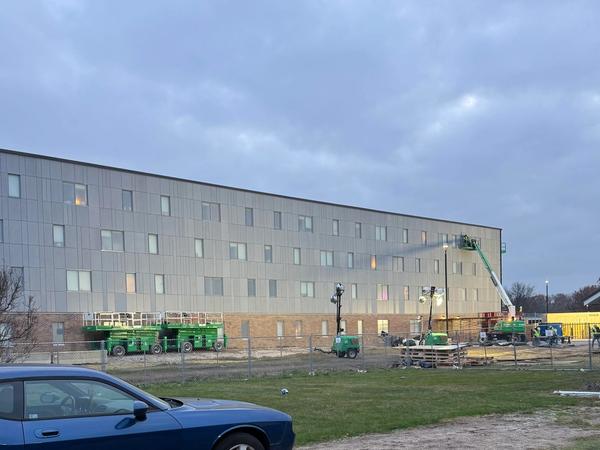
Oberlin’s most recent construction project, the new Woodlands dorm, holds some clues about their current attitudes towards unionized labor. Their choice of contractor, Gilbane Construction, gives some indications as to where their preferences may lie.
According to a 2016 article published by CONSTRUCTIONDIVE, Gilbane Construction has been a key player in the switch to non-union labor. That’s specifically for private construction projects in cities like New York and Boston. William Gilbane III, the current head of operations in New York city, contends that union work rules like “expensive laborers to push buttons on automatic elevators,” drive up costs.
While union labor is known for being more expensive on paper, recent studies such as a 2021 report published by the Natural Resources Defense Council show that this is part of a trade off for a stronger guarantee of quality and timeliness as compared to private labor. As we began looking into the details of the Woodlands construction project, we found several places where the project had not lived up to these standards. According to a recent bulletin from the Facilities Planning and Construction office, construction hit a snag this fall when it was discovered that the vapor sealant used to waterproof the building had a manufacturing flaw. Now that the project has extended into late November, work hours need to be planned around precipitation patterns, and that’s further limiting productivity. Though it is difficult to say what the outcome would have been if Oberlin had chosen a fully unionized contractor, it is certain that there would have been more funding to ensure the administrative organization and timeliness of this project. On top of this, the fact that this is the first setback that has emerged during construction does not mean that it will be the last. An article published by the review in late October said that there have been multiple complaints from residents regarding electrical issues and overly-sensitive fire alarms. We were lucky enough to get a few woodland residents to share their thoughts on the appliances in their unit.
“My sprinkler was falling out and they had to push it back in”
“The water’s been cold recently, but we’re not the only dorm dealing with that issue.”
“It’s like a pink residue that outlines where the water level was”
“Yeah, that’s everywhere that there’s standing water so both the shower and the sinks have a lot of pink stuff on them.”
Another thing to consider is that oversights in construction don’t reveal themselves immediately in all cases. Some of the time, the most critical defects don’t become noticeable until years after construction has finished.
As part of this investigation, we hoped to speak to several administrative offices within the college in order to get their input on this topic. We ended up contacting the offices of Facilities Planning and Construction, the office of the Vice President, the office of the President, the office of Communications, the office of Human Resources, and the office of Residential Life. While some of these gave us no response at all, others informed us that they would not be able to speak on the subject or that “other offices would be better equipped to answer them.” We frequently found ourselves being referred to the same non-responsive offices that we already had tried contacting. When we reached out to Chief Facilities Officer, Joseph Comar we were happy to see that he showed some interest in answering our questions over email. However, after we sent him our list of questions we received no reply. A day later, the office of communications reached out on his behalf, explaining that the subject matter of our inquiry involved “sensitive financial or proprietary information”. When we determined that email inquiries would not provide the results we were looking for, we tried a more direct approach.
Speaking to workers and supervisors at the Woodlands jobsite did give us some useful information, but there was still a noticeable lack of transparency regarding the project.
After talking with an intern in the supervisor trailer, we were referred to Gilbane’s marketing department, then the college's communication office. Though many of the workers we spoke to were kind and approachable, they got quiet really fast when asked about their opinions on Gilbane Construction and on unions. We managed to get the contact information of one worker after we assured him that he could remain anonymous. However, when we contacted him again to confirm the details of the interview, it seemed like he had changed his mind about speaking.
CONCLUSION/OUTRO
Though we expected some level of discretion from Oberlin and Gilbane when it came to talking about unionized labor, the systematic efficiency with which our inquiries were turned down was disappointing. At this point, it’s impossible to say the extent to which the information withheld from our investigation would have been damaging to the reputation of Oberlin or Gilbane. What we do know is that the lack of communication on these topics represents a significant break in trust between Oberlin’s student body and its administration. While talking to the Gilbane workers, we were positively surprised to find that some of them were quite content with their work conditions. When we looked into this a bit further, we found that Gilbane has been known for enforcing even stricter work safety regulation than OSHA in some cases. If a representative from any of the offices we reached out to took the time to give an honest response to our questions, it’s very likely that the truth behind Oberlin’s labor practices is less damning than many students might think. However, without responses from the administration, building a trusting relationship with the student body will unfortunately remain a distant fantasy.
LILY
Conflict between students and institutional administrations is impossible to avoid in higher academia. Community members are saying those who make decisions that have a large impact on their community should demonstrate a certain level of accountability. Where this obligation reaches can’t be exactly defined. However, an administration that chooses to use mottos like “Labor and Learning” should strive for transparency when making decisions about the college's labor practices.
We would like to thank our interviewees for providing us the information we needed for this piece, Jan Cooper for teaching us how to be great journalists, and shoutout to Ben for writing and playing that piano piece. Thanks for tuning in.