The Whimsical World of Oberlin Architecture
2025-02-02T00:00:00.000Z
By Naomi, Liv, Elias, Oscar, Skylar
In spring 1833, An established carpenter from the nearby town of Brownhelm built a cabin for his family in what we now know as Oberlin. This man was Peter Pindar Pease.
Naomi:
In spring 1833, An established carpenter from the nearby town of Brownhelm built a cabin for his family
in what we now know as Oberlin. This man was Peter Pindar Pease,
Skylar:
Is that really his name?
Namoi:
Yes, he was the first Oberlin settler. His intention had always been to create a college and by that
December, 29 men and 15 women began classes as the first students of the Oberlin Institute.
Elias:
Today, there are more than 3,000 students attending the college and more than 70 buildings! I’m Elias.
Naomi: I’m Naomi.
Oscar: I’m Oscar.
Olivia: I’m Olivia.
Skylar: And I'm Skylar.
Elias:
With its almost 200 year history, we thought it would be fun to have a look at some of Oberlin’s most
iconic and well known community buildings and learn about their history and hiding places.
Skylar:
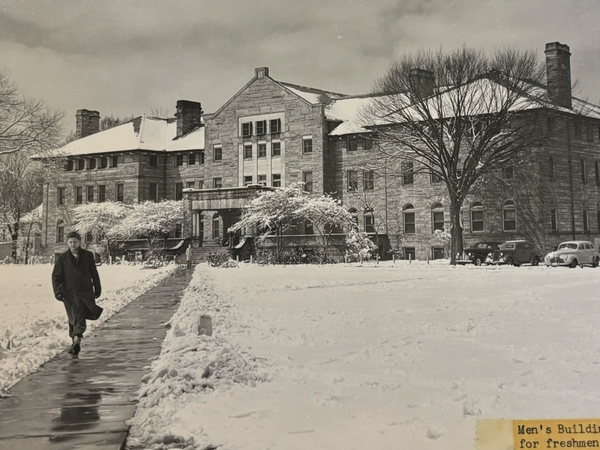
Wilder was built in 1911 in a Richardsonian Romanesque style. The main features of this style, like
turrets, short columns, arches, recessed entrances, are evident on campus and in Wilder Hall. The architect
was Joseph Silsbee who also designed the Memorial Arch in Tappan Square. Archivist Kenneth Grossi
had this to say.
Grossi:
Well, it was, it was built as a men's dorm. You know, there was a need for that, so it's a, it's a fairly large
complex. Um, I think it was in the 1950s that it, it kind of transformed into more of a, what we think of as
a student union. There was certainly, there was a snack bar in the basement. There may have even been a
bowling alley in the basement at one time.
So, it became, you know, kind of transformed from a men's dorm to what we think now is the student
union. But, Now a lot of different things that are happening in Wilder, of course it just underwent a
renovation as part of the SIP project, but uh, you know, its functions over the years have changed much
like a lot of the other buildings on campus.
Oscar:
In the past two years, Wilder has undergone a series of renovations, including a new HVAC system, new
gender neutral bathrooms, the Multicultural Resource Commons, additional meeting spaces for student
clubs, and a new Electronic Locker System for Student Mail.
All: Huh, that's cool. But I’m curious about these hiding places.
Oscar:
Wilder has a few oddities that lie within its walls, for one: the layout is strange. After clambering up to the
third floor, you’ll find two sets of stairs, one leading to the fourth floor, and one leading to a third and a
half floor. Archivist Grossi says that he assumes because the building had been originally a boys dorm,
they were trying to fit as many rooms into the building so as to fit as many people as they could.
Olivia:
Rising up to the fourth and final floor, there’s a hole cut out in the side of the wall into the attic. Likely for
maintenance purposes but it is odd because there is an actual entrance to the attic on the west side of the
building, so pretty weird they would cut a hole in the wall. Through there we found a way up to the roof
of the building and an assortment of odd items scattered throughout the room. Boots in the middle of a
circle of nails, shattered bottles strapped to support beams, and more.
Naomi:
Now let's walk over to warner! Warner is home to the dance department, but that wasn’t always the case.
The construction of Warner was completed by 1901, the architects being Paton, Fisher and Miller. The
style mirrors that of Refined Richardsonian Romanesque or Eclectic Revival. With these two styles, you
would expect heavy stone, arches, and a general mixing of different types of architecture. Initially
Warner’s north side stopped where the main stairs are, but with additional funding from Warner himself, it
was expanded in 1912. Warner Center was almost taken down twice, once in 1920 and again in 1970.
Skylar:
As you can see, this did not happen. As a matter of fact in the 80s it got a small update. Campus manager
Edward Thompson created a stone platform with little stone seats as an outdoor stage for performers to
share their craft. However, the Warner Center we know today wasn’t always a home to the dance
department. Originally, it was built as a gym. It included an indoor track and playing surfaces on the
second floor for basketball and gymnastics. As it was built for this purpose, the floors are well suited for
dance and theater, which is what Warner is used for today.
Elias:
If Wilder’s layout is strange, Warner’s layout is wild. With narrow, wandering passageways, staircases
that lead to nothing, and bathrooms where you have to go through the showers to wash your hands. Paton,
Fisher, and Miller really must’ve been going through it when they made Warner Gymnasium. Now let’s
hear from Daniel James, who is Warner's technical coordinator.
Skylar:
The bathroom that's like right there with that like, the showers don't work and like the bullhead on the
wall. Like, do you know why that's there?
James:
A few years ago there was a student who wanted to turn that into a little, um, botanical garden. So the
department chair at the time didn't want to keep it, so we had to get rid of it, but I kept some of the
artwork, so stuff that didn't have to be tended, and I didn't have to remove it, so.
Oscar:
Warner is also home to many of the theater program’s props. While exploring we found multiple caged off
areas of various props used for past, present and future shows. One particular room connected to the
basement boys bathroom was especially striking. Vintage cassette players, old school cameras, wigs,
masks, multiple kitchen sets, and probably a hundred thousand pieces of jewelry, it was a vintage
enthusiasts haven. What was interesting was that we found lots of seemingly non-prop items there too.
Yearbooks from decades before, notebooks and journals with writing, sketches and even some sheet
music. Up the stairs past Warner main is the creative nook. A little spot on the stairs with an assortment of
pillows and cushions that creatives are encouraged to use to read, write, create, or just wind down and
cool off. Science is still trying to figure out the hero who created it. As interesting as Warner is, let’s
move on to Oberlin’s most iconic building. Peters.
Olivia:
Many students affectionately refer to Peters as the most “hogwarts-like/hogwartsian building on campus”
and that can be attributed to its long history and architecture. Peters is one of the oldest buildings on
campus still standing today, having been constructed in 1887 and designed by Weary & Kramer in a
Victorian Romanesque and Queen Anne style. The main features of these two styles include decorative
plaques, squat columns, sweeping staircases, and towers, just like the mysterious locked one in Peters
Hall.
Naomi:
A tower was actually built for the observatory, which wasn't created and installed until 1929. Similar to
Warner, Peter’s has undergone plans for demolition and renovation. In 1992, the College wanted to take
down Peters because of its age. However, the president at the time, Fred Starr, led a campaign against it.
More than 1300 donors ranging from alumni from the 1920s to current freshman at the time petitioned
against it. The very next year, Peters began renovation. With that renovation came the language lab, new
classrooms and a more durable observatory deck.
Skylar:
Apart from the Observatory dome, the Peters spire is without a doubt the most eye catching part about the
building. It’s closed off but there is a way in. Connected to the language lab on the third floor is an office
on the east side. A closet esc door opens up to reveal a secret spiral staircase. Climbing the stairs you’ll
find two rooms, one on top of the other. These rooms were never renovated and have since been left to
collect dust. The top room has a door leading to the roof, likely for maintenance.
Elias:
Apart from the graffiti left by students who snuck up there, the rooms are empty. We’re not sure if this
space was used for anything in the past but it was likely just for storage and access to the roof. But that’s
mostly speculation. Abraham Reshad, who works in the office that houses the entrance to the tower, had
this to share.
Skylar:
Do a lot of students come by here and try to get up there?
Reshad:
Oh, yeah, there's always at least you know at least five a semester where they're just kind of curious about
the building and they're just looking around and I see and they what happens is is that my door is always
open for students to just kind of come in and ask questions and then you'll just have a couple just kind of
walking around quietly and then They'll notice that my door is open and then they'll wander in and they'll
go, Whoa, wait a second. Hello. Uh, and then talk about, Hey, is that the turret? You know, and then,
yeah. So anyways, everyone's really interested in trying to get up here. You know, my first day here, ,
faculty happened to open it up or I'm not sure how the door got open, but it was part of me joining
Oberlin. They would just, they took me up and, and, and then that, it was really interesting to just have
that kind of quick orientation.
Elias:
Also on the third floor just outside the language lab are a set of double doors. Opening them reveals an
ominous blank wall. Looking out one of the windows, it’s obvious there used to be rooms in use, but now
are unreachable. The renovations done on Peter’s have blocked off and limited access to certain places,
like whatever was behind this door.
Oscar:
Everybody uses these buildings, whether it be to grab a snack in Wilder, dance in Warner, or attend a
language class in Peters, these three buildings are frequented everyday by students.
Olivia:
We wanted to cover well-known buildings and teach others about the rich and fascinating history behind
them. Renovations of buildings have created nooks, crannies, and hiding places that are bound to be
discovered by generations of students to come.
This project was created in part thanks to the Oberlin Libraries and archives. For more information about
the architecture of Oberlin, go to our website for a link to the archives. Link
(https://libraries.oberlin.edu/archives). Thank you to Abraham Reshad, Daniel James, Kenneth Grossi,
and the staff of the Tappan Square Dispatch. Lastly, thank you to Elias for composing and creating the
music featured in this podcast.
Elias: We love buildings!!